Certainly in England (and I'm guessing in Spain, France and Argentina as well) World Cup fever is reaching a peak. English supporters are wondering whether, thirty years after ‘30 years of hurt’, this will finally be the tournament in which an England captain lifts the trophy.
The slightly unusual set of interviews after the quarter final of England manager, Thomas Tuchel, captain, Harry Kane, and superstar, Jude Bellingham, made me think of the relevance of top level sport to foresight done well.
After the match, Tuchel complained that "we made life very, very difficult for us... Technical mistakes... Not repetitive enough." Shortly afterwards, Jude Bellingham was fairly robust in his response, "Yeah, well, whatever... It’s difficult out there. It’s a tough shift... Maybe he doesn’t know what it’s like to play in those kind of conditions against Erling Haaland." Kane later clarified that "when he [Tuchel] sees us train and sees the closeness and what we can do...he just wants to see that version of us."
The exchange captured a problem that is just as familiar in foresight. The gap between the controlled environment in which a plan is developed and the conditions in which it must actually work. The difference between training ground perfection and real-world implementation should matter as much to foresight professionals as to top level footballers.
An important element of our Pharos hypothesis is that:
"Foresight only matters if insights are translated to concrete actions...Good futures thinking provides agency, enabling you to shape and adapt to the world. We are active players, not spectators."
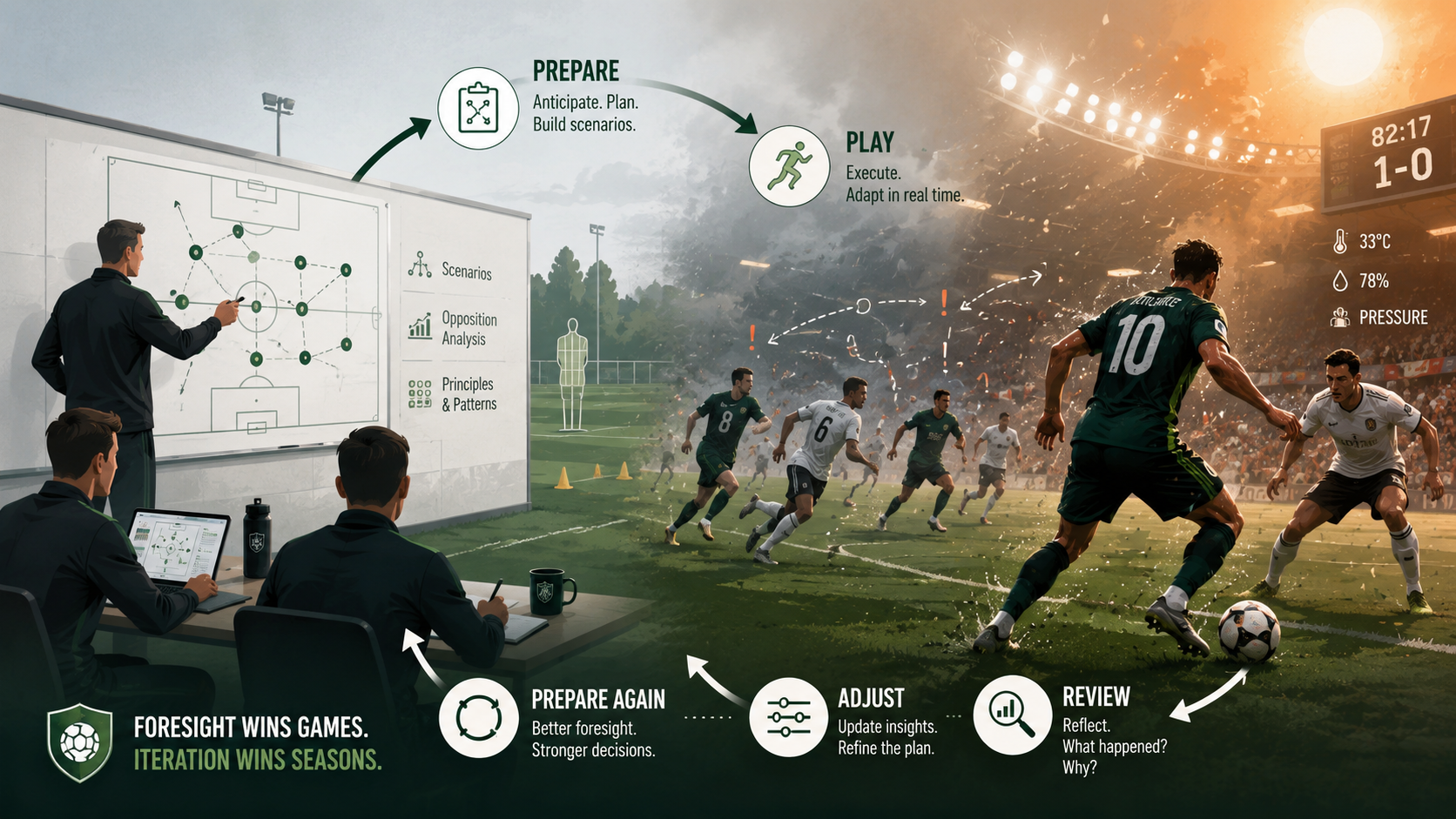
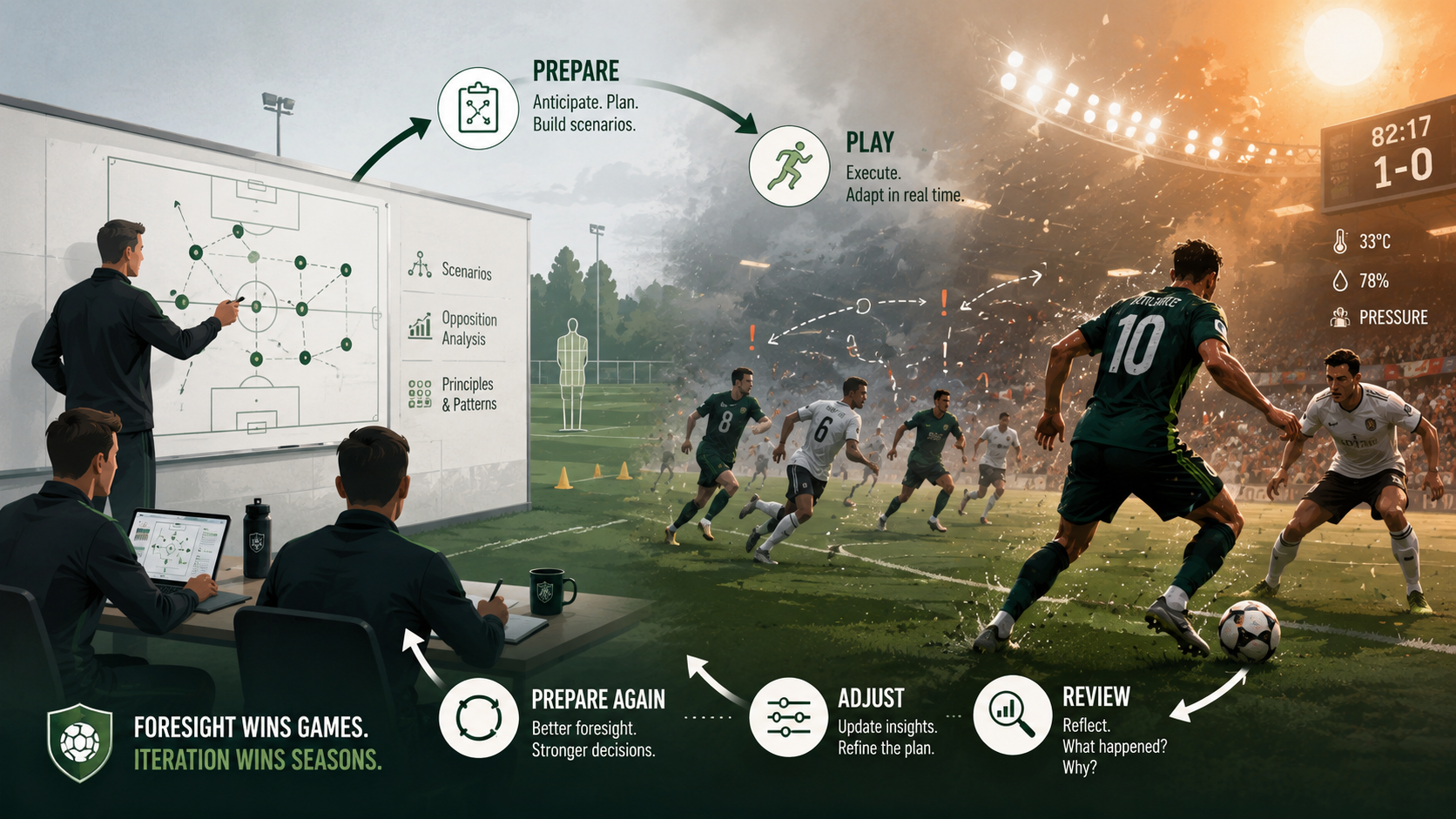
A workshop, like a training ground, is an essential place to develop ideas, test assumptions and build shared understanding. But it is also a controlled environment. The real world, whether it's the stifling humidity of Miami or the lung-busting altitude of the Estadio Azteca, introduces friction that is difficult to recreate in a room: changing conditions, imperfect information, competing actors and opponents determined to disrupt your plans.
That's why it's so important to use the technology now available to move beyond the workshop. Workshops can and should be immersive, but we can now build simulations that expose strategies to realistic pressure, competing actors and unexpected shocks long before they happen. The goal is not to predict the future. It is to rehearse for it.
It's also a reminder that foresight cannot be a one-off exercise. One phrase kept surfacing in Tuchel's post-match interview: not repetitive enough. Top teams do not prepare once and then go hunting for the trophy. They prepare, play, review, adjust and prepare again. As the tournament progresses, that cycle becomes ever more important. Every opponent hands you new information about your own shape. Every match is a live test of the plan you walked in with. A strategy workshop held twelve months ago, written up and filed away, is a plan that has stopped listening.
Whoever lifts the trophy on Sunday will not be the side that arrived in June with the best plan. It will be the side that kept refining that plan through seven matches of rising difficulty, against opponents who had studied them and conditions that refused to co-operate.
An England captain finally lifting the trophy would not be a triumph of the plan drawn up in a boardroom last autumn. It would be a triumph of a plan that kept learning from events and conditions. In football, as in foresight, the winners are not those who simply prepared for what was coming. They are those who kept preparing for what came next.