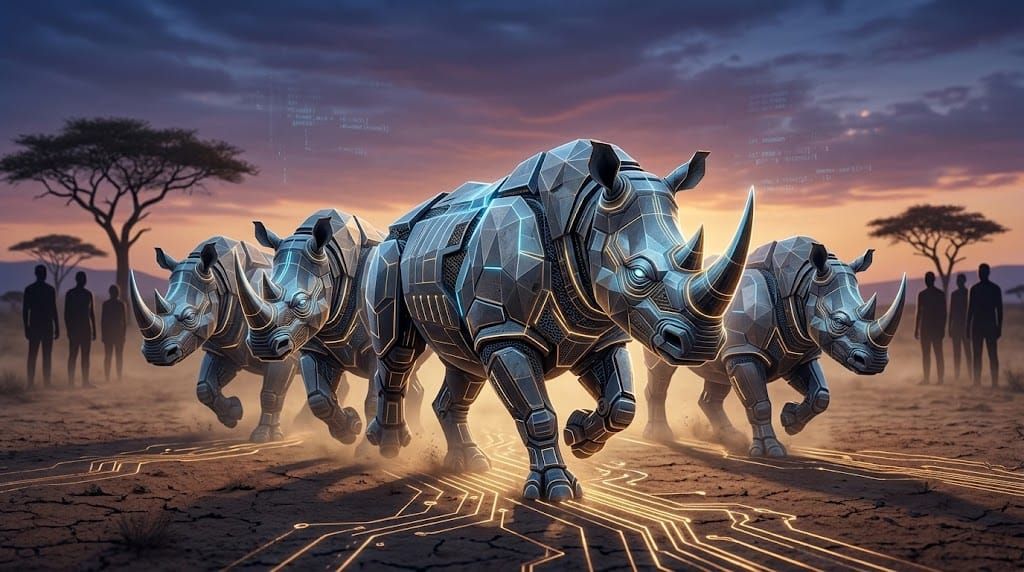
“Rhinoceros” begins with the unusual sight of a Rhinoceros running through the town square. The town people are, at first, shocked and confused. The appearance of the animal rattles the foundations of what’s considered possible. Fairly quickly, though, the idea of humans turning to rhinoceros is normalised and unavoidable, until society in its entirety transformed. All apart from a single man who insists not to surrender his humanity.
Rhinoceros reminds us that things that seem impossible may not be so. It is our present bias often limiting our imagination about the future, making us believe that the way things are now will likely persist. But reality, and people, change and surprise us time and again.
The play is widely seen as a critique of fascism and mass populist movements. It speaks to the human need to belong and normalise our behaviour to match that of the in-group, even at the expense of values through which we define ourselves, even at the expense of our very human core.
But beyond the challenges of social pressure, it asks us to contemplate what it means to know who we are, and to maintain our agency to choose who we want to be. These are ever relevant questions, and they are particularly interesting to explore as agentic AI become more prevalent, and we are offered to outsource more and more of our actions and decision making.
Our agency, at its core, is our will. Our desire. It is what drives us to choose and act. The growing presence of competent machines in our day to day leads many to cognitive offloading whereby we ask the machine to think for us. Agency offloading is when we ask it to will on our behalf. The risk here lies exactly in the trajectory outlined in the play: from something being considered impossible, to being normalised and eventually compulsory.
Today, we are familiar with the notion of “I want x —> the agent can help me get that”. This also turns to “the agent proposes x —> I recognise I want it”. But it can finally lead to “the agent pursues x for me—> I infer that I want it. At this point, I am not choosing to infer, the process has normalised such that I lack other means to relate to my own desire.
No clear explanation is provided for why the characters in the play, especially those who were so outspokenly horrified by the emergence of the rhinoceros, end up desiring the transition to rhinoceros themselves. Their collection of principles shift to one that justifies their actions. In the play, people relinquish their humanity directly and literally. In our day to day, this process of gradual internalised normalisation is more subtle. Our subjectivity, as Foucault observed, involves an ongoing practice of examining and participating in our own formation. It requires challenging the forces that police our behaviour and beliefs (both the external forces and the internalised ones) and making conscious choices about how we live our lives.
The misunderstood version of this suggestion is to reject any norm whatsoever, and use refusal as a forcing function. Which is, inherently, precisely the same kind of deterministic formula dictating actions for us.
No, the ethical work of being a subject cannot be translated to a simple blanket rule. It requires that we use our faculties of human judgement.
The Logician character in the play displays this point well. He is considered the authority of sense-making, but he speaks authoritative nonsense. He demonstrates that having the form of reasoning isn't the same as exercising judgement.
Our judgement is how we exercise our will, and it emerges where we encounter areas of uncertainty that require it, where the world does not tell us what to think and do. Uncertainty, then, is not something that sits within us. It emerges in how we encounter the world, and our will is how we negotiate and interact with uncertainty.
In many ways, AI agents that prioritise and pursue things on our behalf in fact work to remove degrees of uncertainty from our lives. Some reduction of uncertainty can be incredibly helpful, but will we identify the threshold where we outsource the process through which we discover our own will? Technology of all kinds enables us to outsource tasks, mostly extremely helpfully extending the capacity of what we could do without it. Agentic AI can do the same. The question is whether it can increase our capacity for judgment or gradually substitute for it.
It could offer us a “gym for the mind”, not only to avoid weakening our agency, but practice and strengthen it. For that to be the case, conscious design decisions need to be made. And an important distinction will need to be made here is between tasks that can be beneficially delegated, and decisions that have to do with exercising human will and applying meaningful judgement. You might suggest a technology that asks for continuous permission for its every move could solve for this challenge. But in fact, more decisions do not necessarily mean more agency. As suggested in Roy Baumeister’s work on willpower, continuous decision making doesn’t train our agency, it depletes it. An agency enhancing system would identify the meaningful points where judgment matters, and help us practice it.
The protagonist’s distinction in Rhinoceros isn’t that he knows himself better than everyone else. He genuinely doesn’t. He is drunk, confused, and lonely. What sets him apart is that he refuses to outsource the responsibility for what he will become. This is, perhaps, the key to ensuring we make the most of agentic AI and remain the authors of our lives.
Further Reading
- Ionesco, Eugène. Rhinoceros. Translated by Derek Prouse. New York: Grove Press, 1960.
- Foucault, Michel. “The Ethics of the Concern for Self as a Practice of Freedom.“ In Ethics: Subjectivity and Truth, edited by Paul Rabinow, translated by Robert Hurley, 281–301. New York: The New Press, 1997.