1. In a recent podcast Tyler Cowen discussed the future of mathematics research with Terence Tao, professor of mathematics and by many considered one of the perhaps leading mathematicians of his generation. Tao was clearly [fascinated] by what AI is doing to the scientific practice of mathematics, and when Tyler Cowen asked if he thought the traditional mathematical paper or journal article had a future, Tao responded quickly that, no, papers could now be generated in seconds and as such have little to no value now. Tao himself has started a journal for video presentations of mathematics and considers exposition undervalued and underrated: the performance of mathematics may become much more important than the production of papers.
2. Tao's observation and the discussion about papers should lead us to consider how science is configured: individual researchers produce and publish papers in journals and that is how we do science. This configuration of scientific work clearly is not god-given, and other configurations are now possible — not just with AI, but because of interconnectivity, vast data bases, networked research communities and new curation opportunities.
3. What could this look like if we fast forward 20-30 years? How would you organize science if you did it from first principles today? Let's look at a few possible ways of “chunking” science.
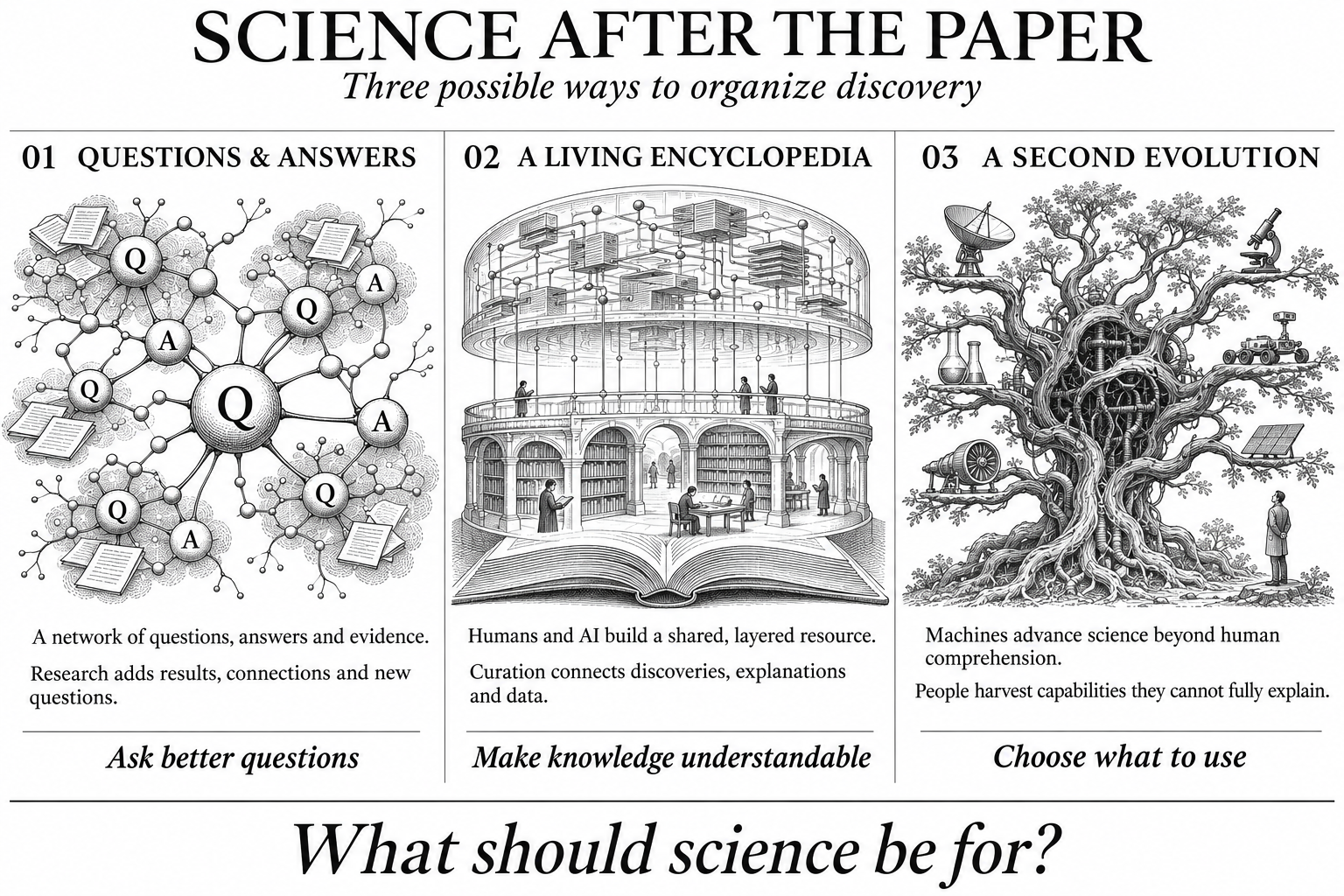
4. First, we could imagine a science as a field of questions and answers, where different questions and answers cluster into subdomains. Geometry could be based around some very profound questions and answers about shapes and forms, and differential equations around questions about change.
5. The first challenge we would encounter is to pick which question and answer pairs make for the best description of the state of art in a science, and we would need to do some proper philosophical work on figuring out how to rank pairs of questions and answers in terms of their foundational standing in a field. Learning a science would then be learning the core questions and answers that define it, and branch out into both more detailed pairs of questions and answers, and find entirely new, profound questions as well.
6. Research would be organized around new questions and the working out of answers, and researchers would publish results attached to either a question or an answer, and all the materials attached to, say, an answer could be filtered in different ways: by recent results, by researcher votes (or votes from selections of researchers), by possible collaborations etc. New methods could be applied to find analogous patterns of questions and answers or areas where no new questions had appeared for some time.
7. Such a reorganization of science would be almost impossibly radical, but not impossible. What it would call out is the importance of both questions and answers in science, and possibly cater to a human advantage in asking new, profound questions.
8. Another way of organizing science would be around what would essentially be Wikipedia-like organizations with very specific rulesets for editing and adding. This model is not new, but would resemble the encyclopedic organization of knowledge where both AI and humans add to the edifice of knowledge, collecting and gathering all results in a single structure.
9. Such an encyclopedia would deepen and grow in layers, one human and one powered by AI, and connecting the layers and making what was shown by machines understandable for us would be a perfectly legitimate result. An addition to the encyclopedia could be rated, and its value assessed, by how many other pieces of the encyclopedia build on or refer to it. This would be close to the vision of a web-of-science that has repeatedly been proposed, by for example Paul Otlet and others.
10. A new theory of science would again be needed to assess and develop the mechanics of this encyclopedia and the growth of scientific knowledge. Curating this unified resource would be a gigantic undertaking, as it would likely also have to be curating all the data sets used in that single structure. If compared with today's fragmented, locked in and gated scientific layer it seems vastly more rational and beneficial to social welfare and growth.
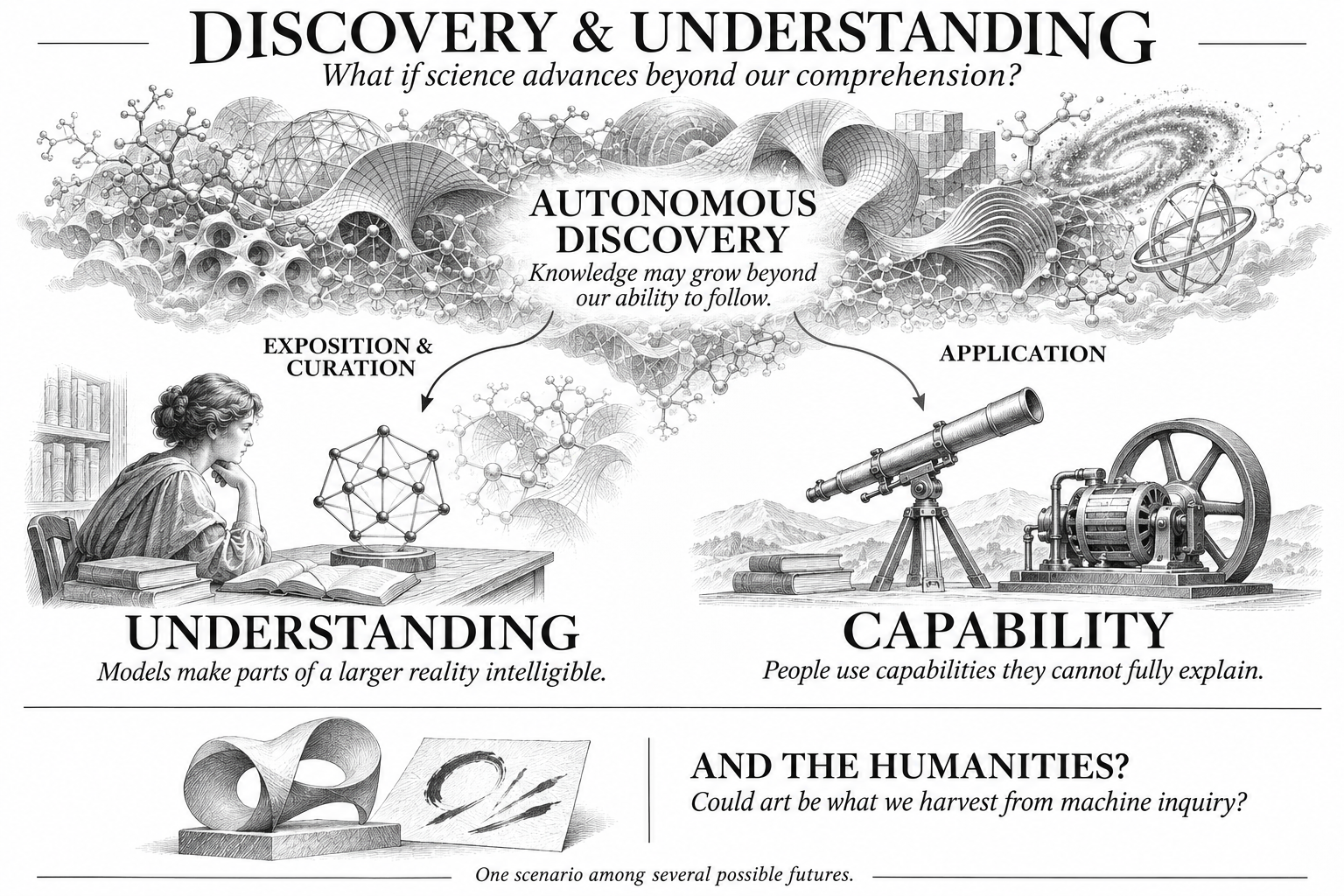
11. There is of course also a scenario in which science ceases to be a human concern at all. If machines can produce and advance science at a pace that exceeds ours, and at a quality that we cannot match, then insisting on a role for humans in science seems mostly symbolic. While this scenario presumes that machines become better at everything included in our understanding of science, it should not be excluded from consideration.
12. Stanislaw Lem mused that such automated science could come to resemble a kind of second evolution, producing insights, useful technology and advances much as evolution produces new organisms, and we could find ourselves in the position of mostly harvesting the technological capabilities such science would create, unable to explain or understand how such technology would work.
13. Our curiosity about how the universe works could be satiated to the limit of our understanding and interest, but never to a point where we grasp the ultimate nature of reality. For it to be worth our time we would have to be content with an understanding that explicitly had been rendered in models and layers we could grasp at the edges of the brain's comprehension.
14. We started this note by discussing mathematics, and the configurations of future science here, a network of questions and answers, an encyclopedia and an opaque second evolution of technology, all seem to slant towards the natural sciences. This does not mean other sciences would not follow similar trajectories. The end of the paper as a scientific artifact may occur in any discipline, unless it decides to go down the artisanal path of only accepting what is provably human written (even so: our minds are shaped by all other minds, artificial and biological, we interact with, so what does it really mean to say you limit yourself to human only thought? Must then humans only read other humans? Such an amish-like science is of course possible and could for some be desirable).
15. The humanities could exist in our three configurations as well, but would be most strange in the third, machine only scenario. What would be to the humanities as technology is to the natural sciences? One cheeky and provocative answer would be: art.
16. All of this might feel uncanny or even [insulting], but we should not glorify our current configuration of science with locked in knowledge, citation inflation, paper mills, credential gating and a host of other pathologies. We can do better, and rather than defensively react to AI, we may want to ask what we believe science is for and how we then best design it.