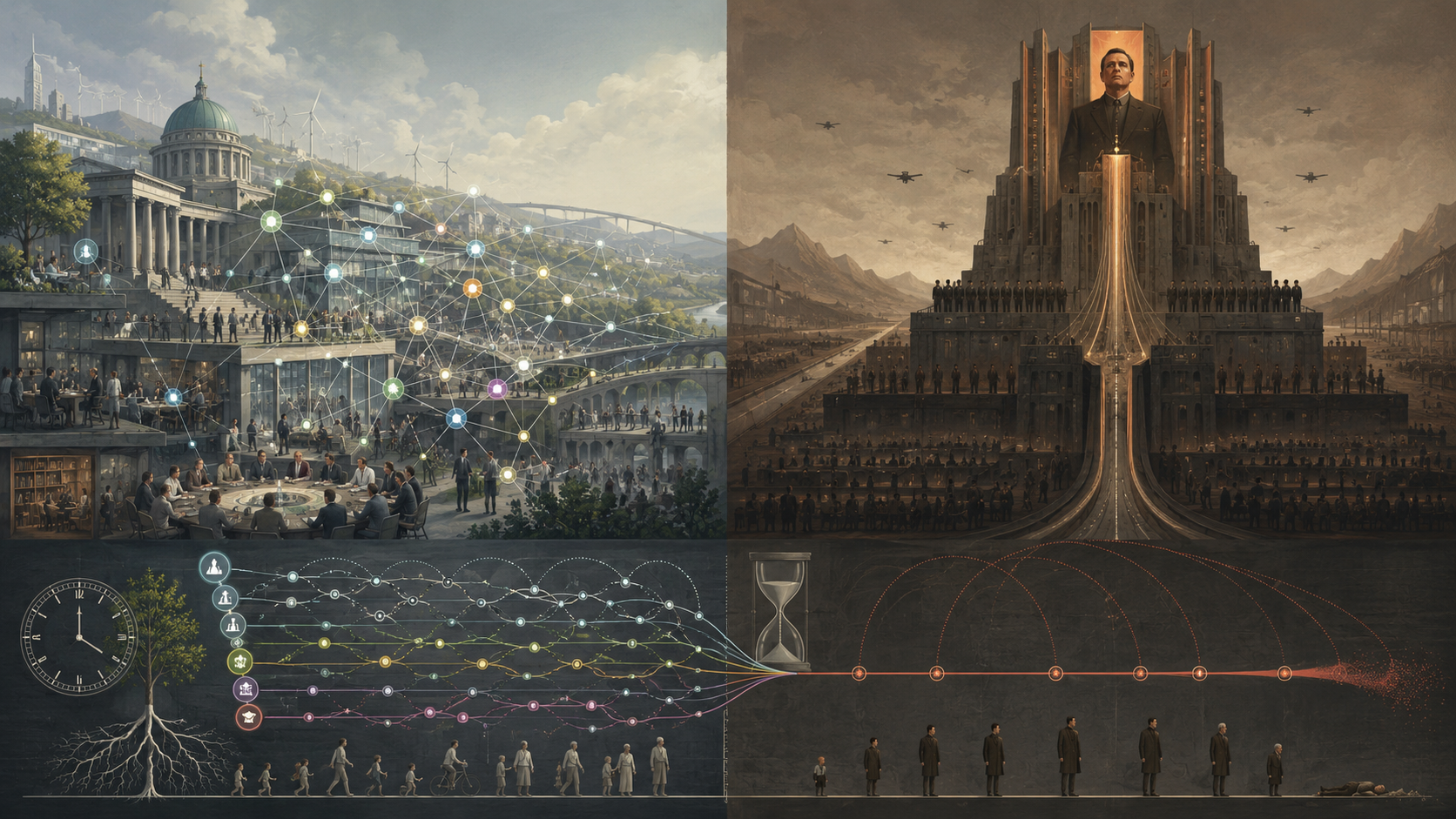
This article in the South China Morning Post made me think about rhythms, and how we deal with them in foresight work.
Geopolitical foresight often tries to incorporate differences in regimes as a key factor in forecasting different scenarios. In doing so there is a need to figure out how different regimes act under different horizons, and also how they interact under those horizons. This is often characterized as an adversarial process, and a commonly held belief goes something like this:
(i) Democracies suffer from a shorter horizon and are rationally bounded by electoral cycles of 4-5 years, whereas authoritarian states can plan for the longer run and are bounded by the lifespan of their leader.
This belief is interesting to explore more in depth. The way it sometimes plays out in scenario-construction is that you assume that authoritarian states have a structural advantage that allows them to dominate democracies over time. The model is fairly straightforward: if you can compete with an actor that can make 4-year decisions, and you can make 40 year decisions, you will win.
But is this true? We could challenge this view from two different angles. The first is that democracies can actually make commitments that are longer than those of authoritarian states, since they can make institutional commitments under the rule of law. Institutions, well-designed, survive generations, and so are longer term commitments than individual leaders can do. This argument reframes the mismatch: rather than being a mismatch between an electoral cycle and a biological lifespan, it is a mismatch between a biological lifespan and an institutional commitment. Under this theory democracies can actually plan for longer than authoritarian countries can, because democracies have the capacity to build institutional frameworks that survive for centuries. This, however, requires that democracies retain and sustain their institutional capacity, making that the differentiating factor in any scenarios: if the institutional capacity of democratic states is strong enough to create inter-generational commitments and rules, processes for decision making, then democracies can dominate the more short-sighted authoritarian states caught in a cult of personality.
The second angle from which we can challenge the idea that authoritarian states have a capacity for longer term planning is to look at bandwidth. Democracies can make more decisions, because they are not as worried about catering to a small governing set of leaders. An authoritarian state under strict personality cult is essentially limited to the decision bandwidth of a single individual, making the state myopic and ill-equiped to deal with the complexity facing geopolitical actors today. This model requires that we have some way of finding out the decision making bandwidth of a state – what can a state make decisions on and how - and then we use that to model competition. An actor that can make a wider range of decisions, across more domains, in a timely manner will dominate one that can make only a few decisions even if those decisions can be made across a longer horizon.
Finally, we can challenge the idea that it is at all possible to make decisions across civilizational time horizons under the kind of complexity that technology, globalization and a thoroughly networked world have created. The idea that a 40 year view beats a 4 year view suggests that there are meaningful decisions to be made in such timeframes - but here we can model the value of decision making capacity as having a sharply declining utility across a ten year period: sure, there may be some decisions that are helpful to make across a ten year period, but most are not. Say you make military procurement, infrastructure and equipment decisions across 20 years - with the current day pace of change in military affairs such long term decision making would actually be a liability.
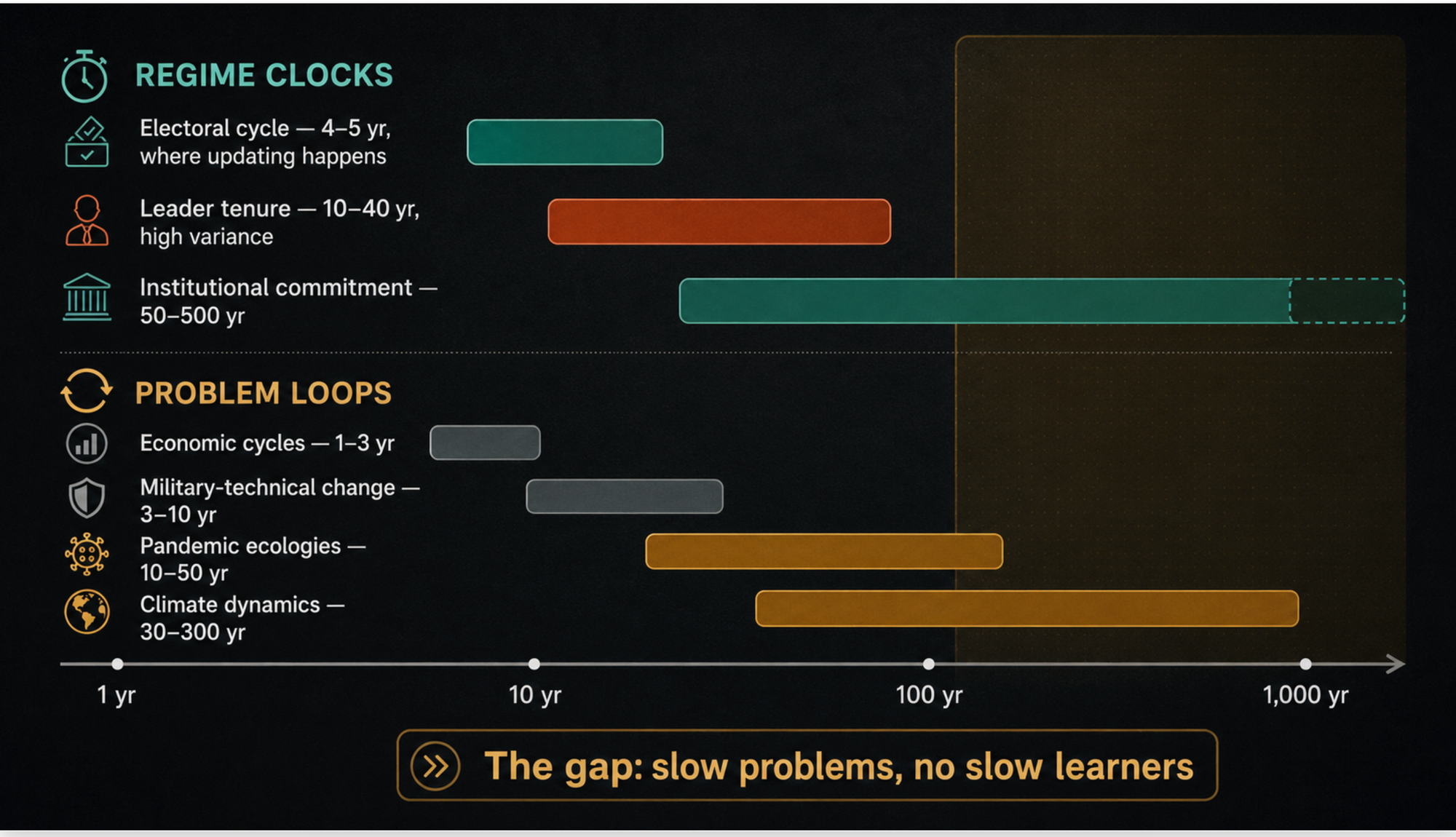
So, how should we model the varying rhythms of different geopolitical actors? Maybe we need a slightly different frame, and here we could try modeling learning rates. At what rate does a democracy learn compared to a more authoritarian state? This has the advantage of focusing not just on time horizons, but on rhythms: the learning pace depends on mechanisms of learning that can be distributed across institutions, individuals and industry in different ways. But just looking at learning rates is probably not enough - since we also need to look at something like the size of the subject learned. Democracies may be great at learning things that can be resolved within electoral cycles, and those shorter cycles actually equate to faster learning – but what can actually be learned in those shorter cycles? Here we find another interesting problem: how can we build institutions for longer social learning? How can we learn about climate change, pandemic ecosystems and other slow systems?
Maybe what we are lacking in democracies, to compete more effectively, are strong institutions for slow learning of big things?