
Demographics for the West look dismal: many countries are quietly disappearing, and were it not for immigration, automation would be a necessary policy rather than a possible labour market threat. But why are we not getting kids? There are as many explanations as there are sociologists, statisticians and political theorists, and among the hypotheses that have been thrown around a strong contender has been that as we become wealthier, and more equal, we spend more time realizing ourselves (and I don't mean this in a bad way - but in the real Aristotelian way) and becoming all we can be, and that leaves little time for surrendering our own time to that of another individual.
This hypothesis essentially says that material welfare inspires spiritual pursuit of self-exploration and such pursuit crowds out crude biological dictates. Under this theory any abundance following on AGI would necessarily mean demographic collapse, since endless opportunity to realize yourself would finally mean shedding the shackles of biology - no need to work for food, no need to procreate. This is the benign, yet somewhat eerie, scenario in which we simply choose human extinction under the utopian completion of all our collective ambitions (incidentally, this is also the preferred outcome of horror writer Thomas Ligotti in his strange book The Conspiracy Against The Human Race (2010), building on what turns out to be a rich heritage of nihilistic anti-natalist views).
A second hypothesis has been gathering evidence fast, and it deserves attention precisely because it is so unromantic: the phone. Its strength is a puzzle of timing. Fertility has fallen in near-lockstep across countries with almost nothing else in common — welfare states and their absence, rich and poor, secular and devout — and the standard explanations diffuse far too slowly to bend curves in unison. Education, secularisation, women's economic emancipation: these move over generations, and cannot plausibly hit Sweden and Senegal on the same schedule. Something arrived everywhere at once, and the candidate list is short.
The case has now been made carefully. In "Is the iPhone Birth Control?" (NBER Working Paper 35310, 2026), Caitlin Myers and Ezekiel Hooper exploit the fact that the iPhone was sold exclusively through AT&T between 2007 and 2011, and use variation in that carrier's mobile broadband coverage as a natural experiment. They find that access to the device reduced births by 4.5–8.0 per cent among women aged 15–19 and 3.2–6.6 per cent among those aged 20–24, that placebo tests on Verizon's and Sprint's coverage footprints come back null, and that the diffusion of the iPhone accounts for between a third and a half of the fall in the American general fertility rate. Their proposed mechanism is behavioural rather than biological: survey evidence on time use points to less in-person interaction, more pornography, and less sex. Working on a global scale, Nathan Hudson and Hernán Moscoso Boedo, in "The Collapse of Teen Fertility in the Digital Era," track smartphone penetration against teen fertility across 128 countries and find the same acceleration in places with, as they put it, fundamentally different healthcare, welfare, economic and cultural environments. They also dispose neatly of the radiation theory: phone use rose across all adult ages, but the birth rate among women aged 15–19 fell by 71 per cent while that among women aged 35–39 rose by 9 — the age gradient runs the wrong way for a biological channel.
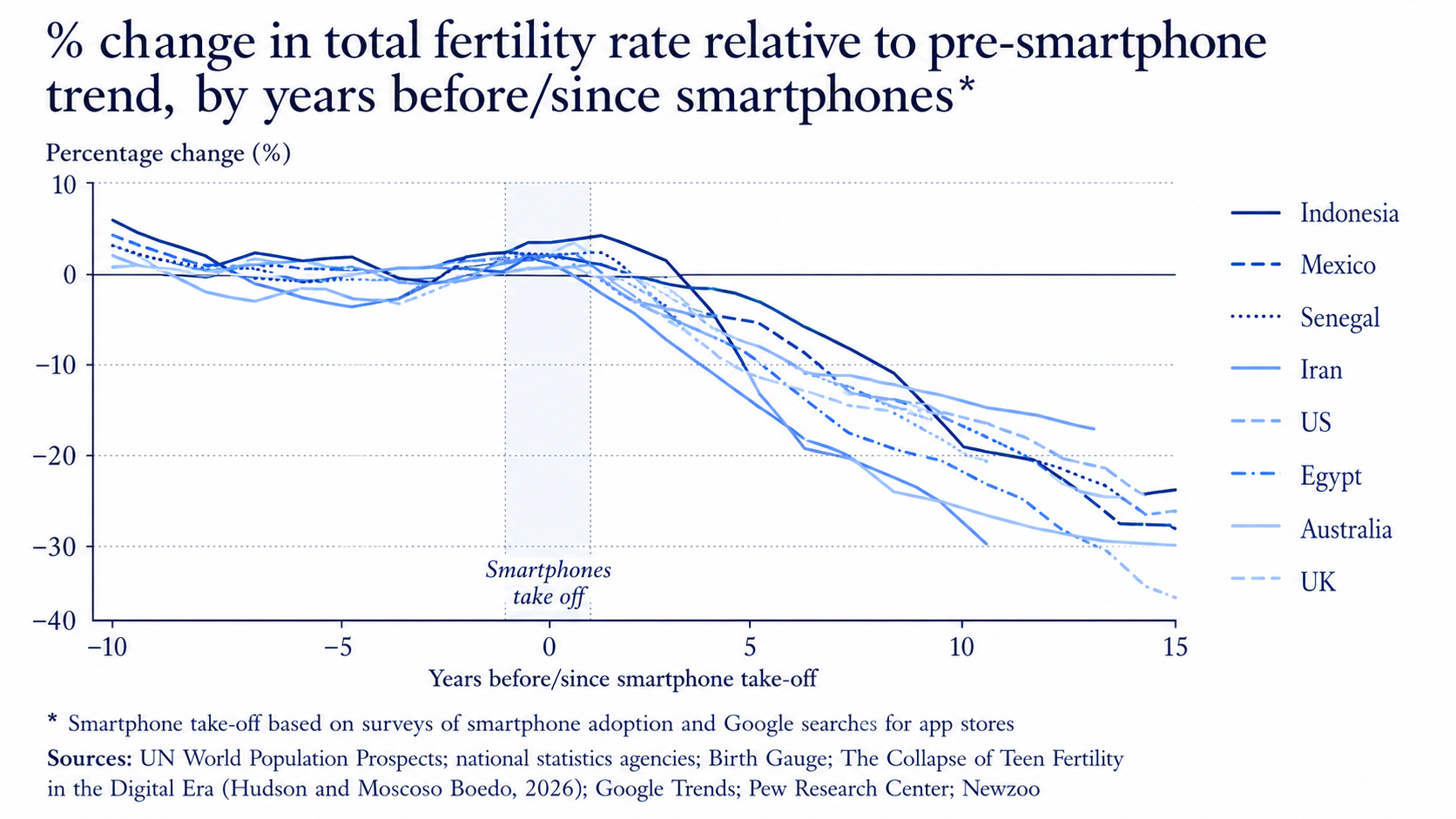
Theodore Joyce points out that American teenage births had been falling since the 1990s, long before the device existed, and calls the hypothesis possibly correct but still speculative. The financial crisis of 2008 sits almost exactly on top of the adoption window in the rich world, and the two are devilishly hard to prise apart. Early iPhone buyers skewed educated and affluent — groups whose fertility was already low. Most awkwardly of all, as Alison Gemmill notes, the window these studies identify largely predates the features we habitually blame: dating apps became mass phenomena only in the mid-2010s, and the algorithmic feed came later still. Jennifer Dowd offers the appropriate methodological caution: we still cannot explain the baby boom, and we should be wary of any account that resolves a demographic trend in one stroke, still less by way of a single electronic device. These are working papers, not settled science.
But what if we bracket these hypotheses and ask if there could be other explanations for the demographic fade that we are witnessing - which other such explanations would then be interesting to explore?
One of the research areas that we are working on is called "demographics is destiny" and in this research programme we are looking at trying to understand the many different ways in which demographics will impact the future. As a key driver demographics is often overlooked or simplified to the point of uselessness, because many seem to think that it is a little bit boring - but we beg to disagree heartily. Demographics is still underappreciated as a key driver in many of the futures that we should care about - and it is not simple, nor boring.
There are a lot of questions we have not asked abot demographics, and among them we find questions like:
- What if we focus not just on aggregate age, but distribution of demographics? What will it mean if older people move to the country side, and younger people remain in the cities? To what degree will urbanization off-set Chinese demographic decline? If we model China as cities, they will enjoy continued population growth for many years, as younger people move in frome the country side.
- Is the real problem of gerontic capture of policies not one of lifespan, but of healthspan? Would health older populations be less inclined to translate their interests into policy outcomes, than those spending the last decade(s) in chronic disease management?
- How should we model and understand global south-south migration patterns? The West has been occupied with north-south migration, but south-south migration is now more than 40 percent and growing fast, and analyzed almost nowhere.
These are just some of the questions we find interesting, but at the heart of the project is this question about why people don't want to have kids anymore, and one possibility is that this actually has to do with fewer and fewer people falling in love. In this scenario, demographic collapse is not caused by increased welfare, or increased focus on ourselves, but on the loss of an infrastructure of infatuation.
Where, today, are you expected to fall in love? Sure, we have apps to meet people, but these apps seem to have decoupled love and sex in a way that is interesting to note (see Büyükeren, Berkeren, Alexey Makarin, and Heyu Xiong. 2026. "The Impact of Dating Apps on Young Adults: Evidence from Tinder." American Economic Journal: Applied Economics 18 (2): 61–106.), and the overall institutions of courtship also seem to have eroded as friends and family have been disintermediated (M.J. Rosenfeld, R.J. Thomas, & S. Hausen, Disintermediating your friends: How online dating in the United States displaces other ways of meeting, Proc. Natl. Acad. Sci. U.S.A. 116 (36) 17753 17758, https://doi.org/10.1073/pnas.1908630116 (2019).)
What if infatuation is a process that requires repeated interactions in a shared symbolic environment? This is, admittedly, a romantic view (it is!) and contrasts sharply with the many economic analyses of infatuation that exist - and the brilliant analysis of the "dating and rating system" that Beth Bailey offers in From Front Porch to Back Seat: A History of the Date (1989). In an article where she explains the ideas she writes:
In dating, a man is responsible for all expenses. The woman contributes only her company. Of course, the man contributes his company also, but since he must "add money to balance the bargain," his company must be worth less than hers (3). Thus, according to this economic understanding, she is selling her company to him. Some men declared, flat out, that the exchange was not equitable, that men were operating at a loss.
But let's stay romantic for a bit - and assume that a shared symbolic world is important, and takes time to build - and for this to happen there is a need for interactions that evolve over time – infatuation is a game, not a bet. Then we realize that this game needs an infrastructure to work, and maybe that is what we have lost - and that love at first sight is not quite what it seems, it has to be prepared.
And Bailey teaches something else: she notes that the dating system was an invention, just as all courtship systems have been – elaborate and co-constrcuted institutions that allowed for the resulting infatuation.
Can we rebuild the infrastructures of infatuation? And by that I do not mean state-sponsored match-making (another version of the "bet"-model of infatuation), but environments that consciously allow for the exploration of shared symbolic understanding of this world that we are in? Or, if we phrase this in a slightly more expansive way: what does the future of making shared meanings look like, and how will we be able to share that meaning with others? And this will not be done by focusing on infatuation, but allowing for it to emerge, slowly, alongside other meaning-making activities.
To sum up, as you probably realize, these different drivers are not exclusionary: they can all exist together. The way increased welfare and phones shift attention dissolve the infrastructure of infatuation in ways that are difficult to pin down, and this complex system is what is really interesting to interrogate. But by focusing on not just single mechanisms (welfare / phones driving demographic change), it is interesting to look at social patterns and infrastructures and how they change. A key belief that underpins any good foresight is that we seek meaning, and the ways in which we do that shape action, and those actions shape the future.