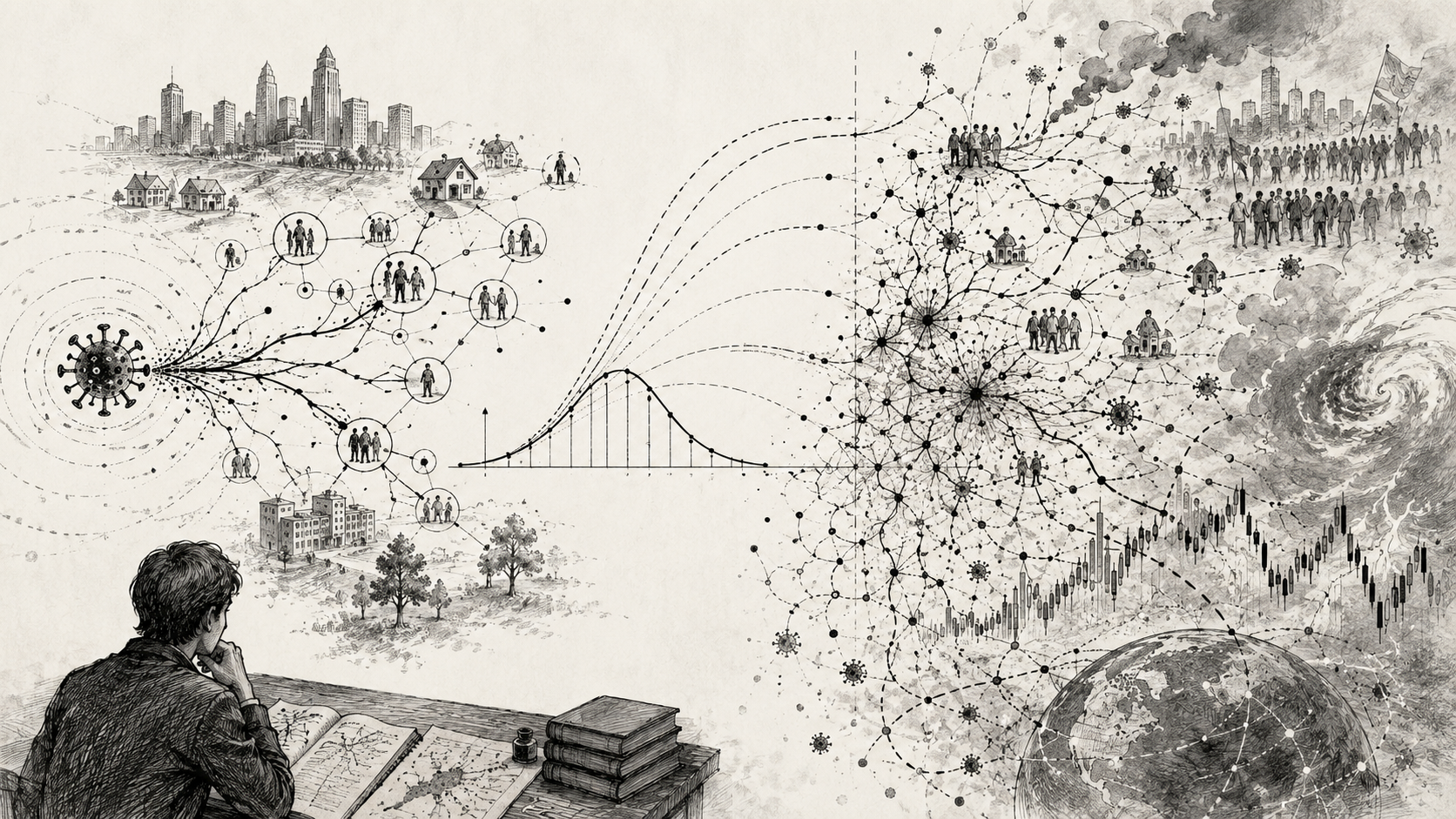
The last couple of decades have made disease forecasting — being able to predict numerically how epidemics evolve, cases grow and what measures can help limit outbreaks — into a viable option. This in itself is a huge advance, and can make an enormous difference in managing future outbreaks.
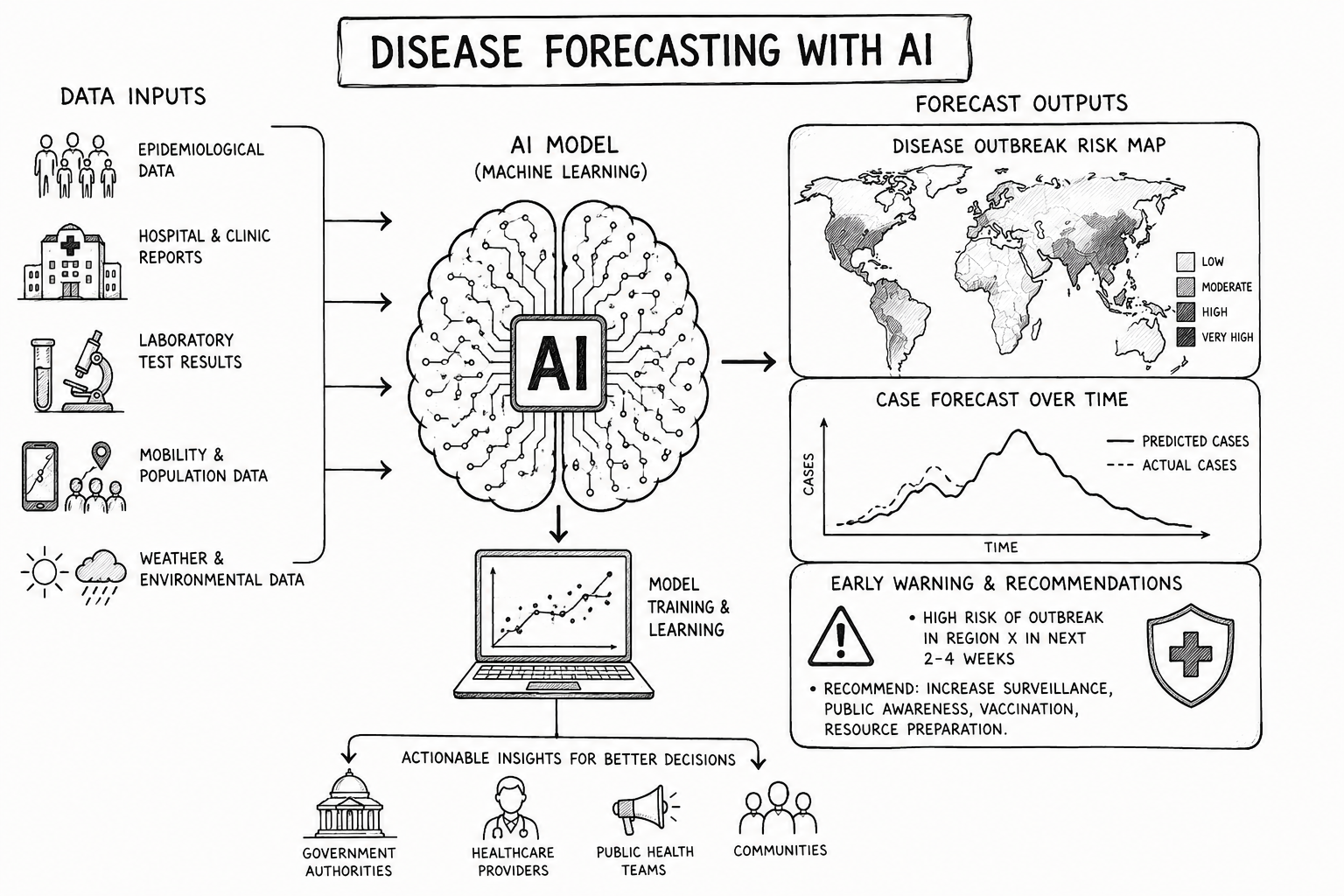
Disease forecasting, however, also provides us with an interesting test case for forecasting any complex system where there is an interaction between people, environment, some agent (a virus) and other factors. What we learn from disease forecasting could be used to model other phenomena like sentiment, political unrest and similar things.
If we accept this analogy there is an interesting lesson to be learnt from disease forecasting about limits — and it can be stated as a single claim, which is what the rest of this post is about: in times of structural instability and rich branching, foresight trumps forecast.
The model: events that make more events
One way to model this is as a branching process, in a Hawkes process. In its simplest form a Hawkes process runs in time alone; the version we want here is the mutually exciting one, where events at one node make events at neighbouring nodes more likely — a branching process running over a network.
A Hawkes process is a way of describing events that happen at random times but arrive in clumps, because each event makes more events likelier for a while afterwards. Take a disease: most days, nobody in your town is sick, and then one person catches something from a traveller — that's a random spark out of nowhere. But once they're sick, they pass it to a few other people over the next week, and those people pass it on, so for a while cases keep coming; then it fades and the town goes quiet again until the next incident.
Markets work the same way: usually stocks tick along calmly, then some bad news drops and one big sell-off happens — and that sell-off scares other people into selling, and their selling scares more people, so you get a frantic hour of crashes bunched together, and then things settle. So there are two ingredients: a background rate of events showing up on their own, and a boost that every event adds to the chance of more events, a boost that fades as time passes.
To describe any of this you only need two numbers — how many follow-on events one event typically causes, and how long the boost lasts before it wears off. And the key thing is what that first number does: if one event causes less than one new event on average, the clump dies out on its own; if it causes more than one, it grows and grows. That's the same tipping point as the contagiousness in an epidemic.
The limit is not a number of weeks — it is a ratio of two clocks
One key assumption here, however, is that the structure you are forecasting is somewhat stable: same nodes, same connections, same rates of transmission along them. And this is where the real lesson sits. It is often said that numerical disease forecasting has a ceiling of three to four weeks. That is true, but it is a measurement of one particular kind of system — fast respiratory epidemics — rather than a law about forecasting as such.
The general principle is a ratio of two clocks. On the one hand, how long it takes one event to produce the next; on the other, how long the structure holds still. If the structure stays put through many generations of spread, you have a stable thing to measure and your numbers mean something. If the structure changes faster than a generation completes, you never really measure the branching factor at all — by the time your estimate settles, it describes a system that no longer exists.
Note that this is not the point where numbers stop and words begin. It is the point where unconditional numbers stop and conditional ones start. You can keep quantifying long past the forecasting horizon, as long as you are honest that you are now saying "if these things hold, then this follows" rather than "this will happen". Scenarios can be counted, scored and audited. They simply cannot be unconditional.
There is an interesting study about this on Covid-19, where the projections — the article calls them scenarios, which is somewhat confusing since we use scenarios for foresight, though the underlying logic is much the same conditional one — typically held for around 22 weeks before a new variant emerged and invalidated the assumptions they were built on. Five times the supposed ceiling, because what mattered was not the calendar but how long the structure lasted. And note what a variant actually changes: not so much who meets whom, but how easily the thing passes between them and who is still susceptible. Structural stability is broader than topology. It covers who counts as a node, what flows along the edges, and at what rate.
Rich branching is itself destabilizing
There is a second-order effect worth naming, because it is where the model starts to say something political.
A high branching factor is not enough for systems to become unpredictable. A disease with a very high reproduction number in a stable population is entirely forecastable — it simply says that the thing takes off and fast. What makes forecasting impossible is instability, and instability bites hardest when the branching factor sits close to the tipping point, because that is where a small structural change flips growth into decay.
But rich branching produces variations of instability. Fast spread triggers lockdowns, circuit breakers, border closures, capital controls, content moderation, emergency legislation. The control loop tears up the structure precisely when spread is fastest. The system generates the exact response that invalidates the model of it. This means that populism and nationalism could be read as the endogenous response of a high-branching system — the immune reaction (for better or worse) rather than the treatment.
Are uncertain times simply unstable structures?
All of this teaches us some basic things about the forecast/foresight limit and how it changes with the systems we engage with. But it also allows us to ask a rather larger question: is what we mean when we say we live in uncertain times really that we live in times of increasingly unstable networks? And if so, should a general policy goal be to stabilize them?
This lens is interesting from a political foresight perspective, because it turns a vague sense of turbulence into something with parameters that can be acted on. In fact the model gives us a complete and rather small set of moves. These might actually be the general political affordances available in any network problem.
Five affordances
1. Lower the branching factor. Reduce how far any single event propagates: firebreaks, modularity, circuit breakers, capital buffers, federalism, redundancy that is not shared. This does not freeze anything — the network keeps changing, it simply stops transmitting so efficiently. It is the move nationalism gestures at and implements crudely, by cutting edges wholesale rather than selectively.
2. Stabilize the structure. Hold the nodes and connections still so that what you learn about the system stays true: standards, treaties, long-term contracts, constitutional entrenchment, professional norms, institutions with long memories. Nostalgia and nationalism are the low-quality version of this move; institutions are the high-quality version. They are attempts at the same thing, and it is worth being clear that the goal is not absurd even where the method is.
3. Slow the clock. Lengthen the time between one event and the next, which improves the ratio without freezing anything: trading halts, cooling-off periods, deliberation requirements, mandatory waiting times, friction deliberately introduced into information flows. This is the most underrated affordance, because it buys forecastability without buying rigidity.
4. Speed up your own loop. Instead of extending the window in which your knowledge holds, shrink the decision cycle until it fits inside the window you have. Much of what we call state capacity is exactly this: the ability to decide and act inside the period during which the analysis is still true.
5. Instrument the assumptions rather than the outcome. Stop monitoring the thing you are forecasting and start monitoring the conditions under which your forecast remains valid — variant emergence rates, policy churn, platform changes, the rate at which relationships are formed and broken. Build the early warning system on structural decay rather than on the phenomenon. This might be the one that transfers most directly from epidemiology to policy, I think.
The dilemma
The obvious objection is something like stability and adaptability are the same dial. A structure stable enough to forecast is a structure that cannot reconfigure. Everything that makes a system predictable also makes it worse at responding to what it did not predict, which is the old resilience-versus-efficiency trade-off.
Stabilizing a network in practice means excluding nodes and cutting edges, and the cost of that falls on whoever gets cut rather than on whoever does the cutting. Nationalism and nostalgia are probably examples of this. The trouble is that the ones paying are rarely the ones choosing.
So "stabilize networks" cannot be an unqualified policy goal. It buys predictability with adaptive capacity, and it buys it on credit extended by other people. Which leaves us with a genuine dilemma rather than a programme — and, I would argue, with a fairly clear task for foresight: to be explicit about which of the five affordances a given policy is actually reaching for, what it costs, and who pays.