
The use of artificial intelligence in strategic foresight research is still a contentious issue. There are those who feel that foresight needs to remain a purely human activity - and their argument is far from luddite. In its strongest version this argument goes something like this:
The process of producing foresight is as important as the products produced, and should not be hurried. There is a limit to the speed with which humans can develop, engage with and integrate models and scenarios of the future, and attempting to speed that up will create a deepening disconnect between the volume of output and the legitimacy and usefulness of that output.
Essentially: if you use AI you will just generate trend and horizon scanning slop. I think that is fair, but it simultaneously underestimates both the complexity of the foresight process and the improvements that can be made to its efficiency, and a new study out recently, based on the introduction of AI-augmented foresight at Siemens Education, seems to corroborate that:
The findings show that AI integration does not lead to uniform acceleration or automation. Instead, it produces task-level efficiency gains, a redistribution of human effort, and enhanced analytical breadth, structure, and completeness, particularly in scanning, consolidation, and drafting activities, while framing, prioritization, contextual interpretation, legitimacy building, and accountability remain firmly human-led. Empirically observed trade-offs reveal persistent tensions between speed and legitimacy, analytical breadth and strategic focus, and standardization and organizational contextualization.
The trade-offs are there, to be sure, but the gains are significant, and captured well in this table:
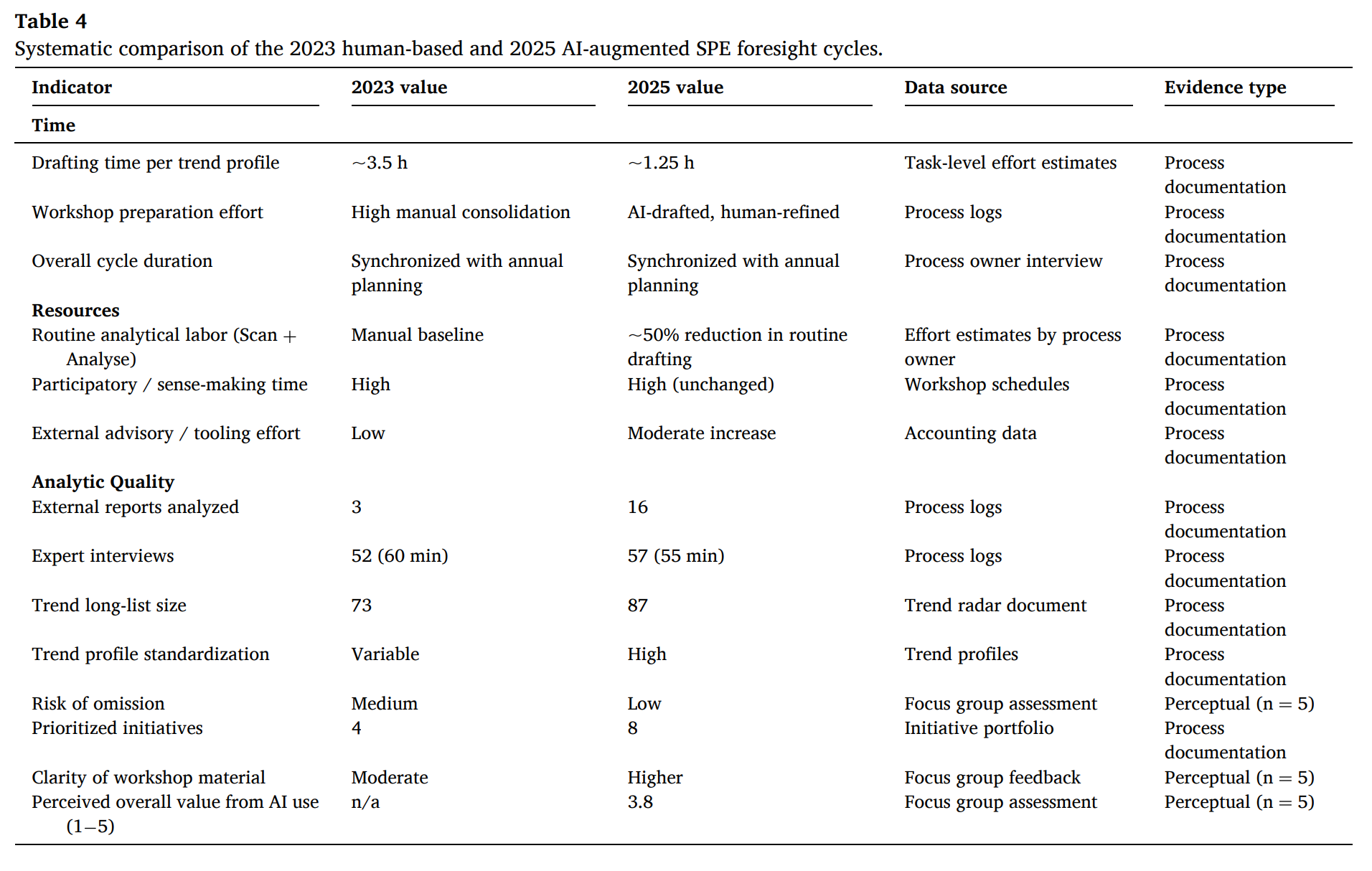
Note especially the increase in the number of studies that could be digested, and the reduction in routine drafting. Now, this touches on an insight that seems to have been lost in the discussion about AI-writing: not all writing is the same. Summing up a report, clearly stating an argument and writing a review of literature are things that have often been seen as routine work in research teams - and that this is now outsourced to AI seems natural, freeing up more time for analytical work. What does not change, however, is the sense-making time, and that does probably represent a non-negotiable time investment for anyone serious about foresight. Figuring out how different futures make sense means integrating them in our understanding, and that happens at a variable, but capped, individual human speed.
The breadth, the ability to take into account more sources and integrate them into foresight work, is what stands out to me here, and I do think that this is a key advantage. The authors also sound a note of warning that is worth repeating:
Across the results, AI integration emerges not as a linear improvement, but as a reconfiguration of foresight work. The five empirically observed tensions between speed and legitimacy, breadth and focus, standardization and contextualization, structured ideation and radical novelty, and augmentation and accountability, are recurring trade-offs inherent in hybrid foresight systems. From a theoretical perspective, these tensions highlight that foresight is not reducible to information processing. Rather, it is a socio-cognitive practice in which knowledge production, sense-making, and decision justification are tightly coupled. AI strengthens foresight where tasks benefit from scale, structure, and repetition, but its limitations become visible precisely where foresight intersects with organizational politics, identity, and responsibility. This finding extends existing work on hybrid intelligence by showing how epistemic authority and legitimacy remain anchored in human collectives, even as analytical preparation is increasingly automated. They also suggest that the core challenge of AI-enabled foresight lies less in technical capability than in the governance of human–AI interaction.
Maybe we should start talking about hybrid models of strategic foresight instead – and explore those, rather than attempt to make the machine into a substitute for our own work with the future.
Reading:
René Rohrbeck, Stephan Szuppa, Julia Schmidt, Artificial intelligence in strategic foresight: Evidence from a longitudinal case at Siemens Professional Education, Futures,Volume 183,2026,103883,ISSN 0016-3287,
https://doi.org/10.1016/j.futures.2026.103883.
(https://www.sciencedirect.com/science/article/pii/S0016328726001254)